
Searching for a Warrant in Hartman
Start with the paperwork, not a name search. Copy the issuing jurisdiction, the case or citation number, the court date, the allegation, and the exact spelling of the name. Those fields separate a possible Hartman municipal matter from a Prowers County Court, District Court, juvenile, or federal case. Details matter here. A blank online search proves nothing about whether a warrant exists.
- Read every page of the citation, bond paper, notice, or summons and identify the court and agency.
- Confirm the current Hartman local-government or clerk contact before traveling; no official online Hartman warrant form was found.
- If the document names Prowers County, call Prowers County Combined Court at 719-336-7424 and provide the case number.
- If the issuer is unclear, call the Prowers County Sheriff's Office at 719-336-8050 for routing, understanding that the office may direct rather than disclose.
- Ask the issuing clerk or a Colorado attorney about active status, appearance, surrender, bond, or recall instructions before acting.
No Public Hartman Warrant Portal
Quick answer: Hartman publishes no current warrant roster, online status field, municipal-court calendar, bond window, payment route, or recall procedure.
Hartman keeps no public warrant list online. It does not mean the town has no cases. Small jurisdictions often hold records without a web tool. So skip the people-search sites and skip another city's instructions. The named issuer holds the answer. Colorado Judicial Docket Search can identify a county case setting. It displays no public warrant-status field for Hartman. A docket entry still helps, gathering the courthouse, the case class, the sequence number, and the hearing details. Then call the clerk, ask whether an active warrant exists, and which order controls.
Hartman Police and Municipal Court
Hartman appears in statewide municipal-court lists. A listing is not a live office. It establishes no current calendar, clerk contact, warrant list, or surrender policy for Hartman. Where a local matter is properly pending, the municipal judge controls the court process. Law enforcement serves or executes the paperwork instead. Neither role can be guessed from an old directory. Confirm the current local contact and the issuing court before you act. Also be careful with claims. Hartman has announced no court closing, and no official order moves every Hartman case to the county.
Hartman Warrant Context in 2026
For current local-government context, the Colorado General Assembly hosts SB26-157, “Determination of Town Abandonment,” online. The bill was signed May 26, 2026. It covers statutory conditions around town governance, elections, and critical water infrastructure touching Hartman. None of that touches warrants. The measure is not a warrant law, a recall order, an amnesty program, or a court-closing notice. Its official page documents the legislation only. It says nothing about any person's case in Hartman.
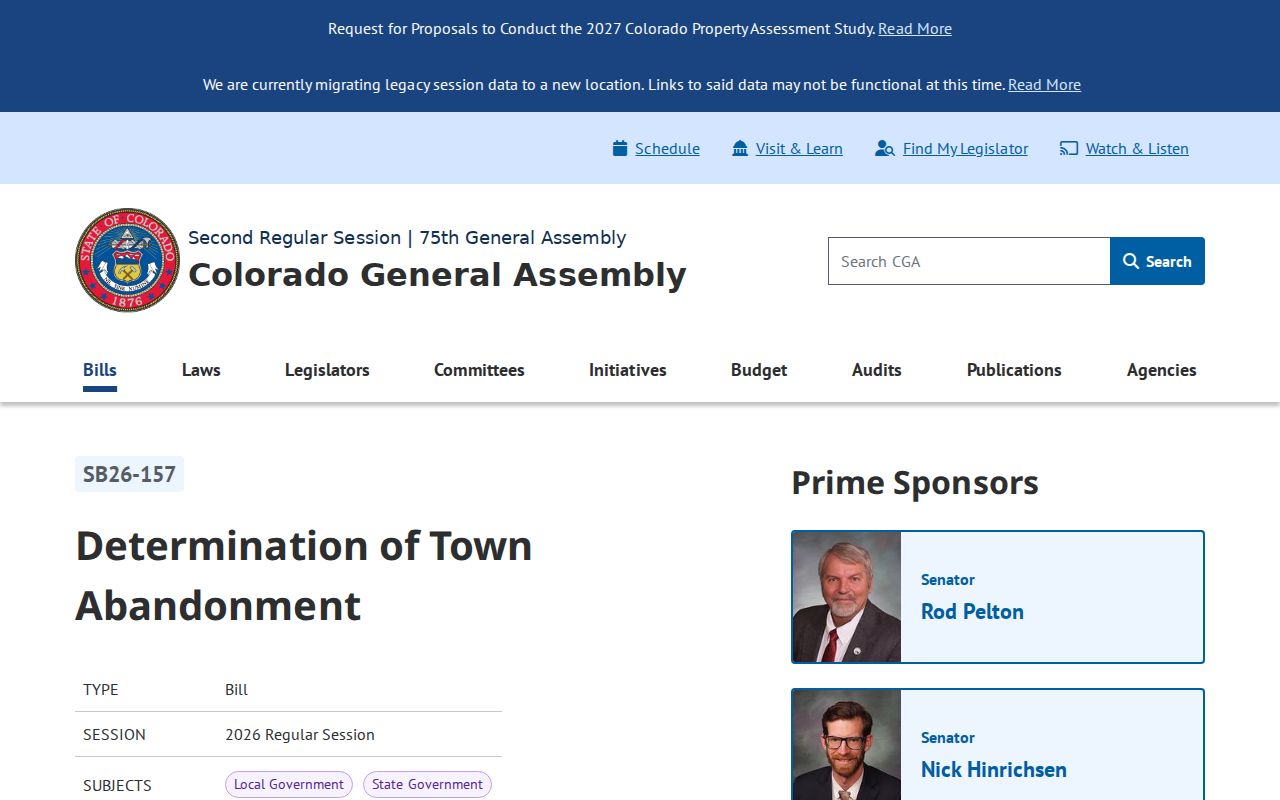
The law does not clear, suspend, transfer, or disprove a warrant. Hartman case status still comes from the issuing court.
Hartman Warrant Types
The warrant type and the issuing court decide where a Hartman question goes. A citation, a docket hearing, a warrant, a bond entry, and a criminal-history record are different things. Call it a bench warrant unless the document uses another label. Not every missed date or unpaid amount produces one.
| Warrant Type | How It May Arise | Likely Issuer |
|---|---|---|
| Municipal bench warrant | A missed required local setting or failure to comply, if ordered under the applicable procedure | Authorized municipal judge |
| Traffic-related warrant | A county or local traffic case in which the court lawfully issues process after nonappearance | Court named on the citation |
| County bench warrant | A missed appearance or court-order issue in a Prowers County case | Prowers County Combined Court |
| Arrest warrant | Court-authorized criminal process supported by the required complaint and probable-cause showing | Appropriate county, district, or other court |
Hartman Warrant Myths About SB26-157
Myth: a law about determining town abandonment automatically closed every local case or cleared every Hartman warrant. Fact: SB26-157 addresses local-government status and related conditions. The bill page contains no blanket warrant recall, court transfer, or case dismissal.
Do not skip a scheduled Hartman appearance because of a headline about the town's status. Colorado Judicial guidance also warns that watching a virtual proceeding is not an appearance. Follow the directions issued in your own case. Confirm them with the clerk. Seek legal advice if a warrant or custody concern exists.
Inside a Hartman Warrant Record
Hartman publishes no warrant record screen online. Treat these as fields to request from the office that holds the file. A name alone can match the wrong person. Read the issuer, the number, the offense, and the status date together, and verify any result with the issuing court directly.
| Case or Warrant Number | The exact court identifier, including any year, letters, and sequence. |
|---|---|
| Subject Name | The name entered in the file, checked with other lawfully requested identifiers. |
| Charge or Offense | The underlying allegation or case description, not a finding of guilt. |
| Issuing Court | The key routing field showing which clerk controls status and resolution. |
| Bond or Conditions | Terms set in the particular case, if any; no other city's published practice applies automatically. |
| Status | The current issuing-agency answer, which can change through issuance, service, recall, quash, or sealing. |
Hartman Warrant Calls Across Distance
Hartman counted 56 residents in the 2020 Census. That figure says nothing about open warrants or caseloads. Prowers County stretches across 1,638.41 square miles, with its main justice offices sitting in Lamar, so a phone call ahead can spare a rural driver a long trip to the wrong counter in search of warrant records. A quick warrant check by phone works better than guessing.
- Write down the court, agency, case number, and date before calling.
- Ask whether the receiving office is the record custodian or only a routing contact.
- Confirm the current address, business hours, required identification, and appearance method.
- Ask whether counsel may contact the court when surrender or custody is possible.
- Do not infer warrant counts from Hartman's population or from county filing totals.
How Hartman Warrants Fit the County System
A Hartman warrant paper will not tell you which court owns the case. It could sit in a municipal channel, Prowers County Court, or District Court. When the paperwork names a county or state case number, start at Prowers County Combined Court. The sheriff serves court process and can route a confusing inquiry. Its website posts no warrant roster, though.
Warrant flow: Hartman local contact / issuing court › Prowers County Combined Court or Sheriff's Office when jurisdiction requires › issuing-agency confirmation
Hartman matters rise to the county level, and two tools cover that ground. Start with Prowers County warrant records, then the county warrant lookup. Combined Court sits at 301 S Main Street, Suite 300, Lamar, 719-336-7424. The counter opens Monday-Friday, 8:00 a.m.-5:00 p.m., closing noon-1:00 p.m., and the Colorado Judicial Docket Search is only a case clue, not proof of active status.
Hartman Warrant Records Requests
Asking for a record is not the same as confirming a live Hartman warrant, and it helps to know the difference before you file anything. A records request moves paper; a warrant check asks a court to tell you where a case stands right now. The strongest requests name the case number, the date, the incident type, the location, the issuing court, and your relationship to the record. The custodian who receives it may hand over the file, redact protected material, deny access under an exception, or send you to a different office entirely. The Prowers County Sheriff's Office sits at 103 East Oak Street in Lamar, reachable at 719-336-8050. Its criminal-justice request form offers no public warrant-search checkbox. Filing a request will not recall a warrant, and a thin response proves nothing about whether one exists. Juvenile files, sealed files, and other restricted records may stay closed no matter how you ask. So describe a specific report or a specific event rather than asking for a broad list of names. The sheriff form can locate material through an incident date, a deputy name, a location, an incident type, or a case number, and its approval, denial, and exception fields show that a human reviews every response. If the item you need is a court filing, take that question to the court clerk and ask about the court-record request process. One vague blast to several Hartman offices just slows routing down and may still leave the issuing court unidentified.
Hartman Warrant Records and Public Access
Colorado public-access law does not open every Hartman warrant field or put every record online. Court records follow Colorado Judicial rules, while criminal-justice records answer to separate custodian and exception standards. Juvenile matters, sealed files, and protected or unserved material may be restricted. Current law, any controlling order, and the originating agency decide what you can see.
Key Rules:
Colorado Open Records Act (CORA), C.R.S. 24-72-201 et seq. - provides access principles for qualifying public records subject to procedures and exceptions.
Colorado Criminal Justice Records Act, C.R.S. 24-72-301 et seq. - governs criminal-justice record requests and applicable disclosure limits.
Chief Justice Directive 05-01 and court-access rules - govern public court records, including sealed and confidential material.
Hartman Warrant Resolution Has No Amnesty
Hartman runs no warrant-amnesty event, no safe-surrender program, no blanket recall, and no published bond window. SB26-157 is not one either. Treat the absence of online instructions as a reason to call, never as permission to skip a court date or show up without confirming the risk and the required process. Start with the issuing clerk. Ask whether a warrant is active, whether a walk-in appearance is accepted, what paperwork and identification to bring, whether bond applies, and whether an attorney can arrange or request a hearing. Only the issuing court can recall or quash its own warrant. Lamar's municipal fee and personal-recognizance rules do not travel to Hartman, so leave them out of the conversation. Before you dial, sort fact from rumor. A case number and an issuing court are printed on your paperwork; a rumor that all town matters moved elsewhere is not a fact. Ask the clerk to repeat the case number, the current setting, and the authorized next step, and write down what you hear. If payment comes up, pin down whether it covers only a balance or actually touches the warrant. Never assume that paying an amount, submitting a request, or leaving a voicemail changes a court order in Hartman or anywhere else.
Hartman Warrant Escalation Route
If you cannot confirm a current Hartman clerk or court contact, do not guess that the case vanished. When the paperwork names county or district court, start with Prowers County Combined Court. If no issuer is legible, the Prowers County Sheriff's Office can route you and tell you whether it holds the sheriff record you want. Keep a written call log as you go: the date, the office, the staff role, the case reference, and the next step. Repeat numbers back before hanging up. When an appearance, an arrest, a bond, or a surrender could follow, bring in a licensed Colorado attorney. Calling first fits Hartman's current local-government uncertainty without turning that uncertainty into a claim about any person's warrant. The Sheriff's records office keeps Monday-Friday hours of 8:00 a.m. to 5:00 p.m. and sends after-hours visitors to the Jail Lobby. Read that as logistics, not as a promise of a round-the-clock warrant-search counter, instant disclosure, or a guaranteed surrender arrangement. Call during the posted hours when you can, state the narrow routing question plainly, and then follow whatever the court or agency with authority over the case tells you to do next.